


Cosmic Milestones: The Earliest Supernova and Martian Water Mysteries
Falha ao colocar no Carrinho.
Tente novamente mais tarde
Falha ao adicionar à Lista de Desejos.
Tente novamente mais tarde
Falha ao remover da Lista de Desejos
Tente novamente mais tarde
Falha ao adicionar à Biblioteca
Tente outra vez
Falha ao seguir podcast
Tente outra vez
Falha ao parar de seguir podcast
Tente outra vez

Cosmic Milestones: The Earliest Supernova and Martian Water Mysteries
-
Narrado por:
-
De:
Sobre este título
Earliest Supernova Ever Detected
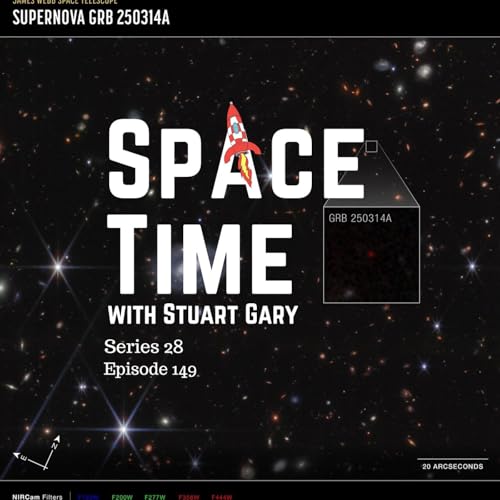
Astronomers have achieved a remarkable milestone by detecting the earliest supernova ever observed, dating back to a mere 730 million years after the Big Bang. Using the powerful Webb Space Telescope, this supernova, cataloged as GRB250314A, emitted a gamma ray burst that has shattered previous distance records. Lead author Andrew Levin shares insights into how this discovery provides a glimpse into the universe when it was only 5% of its current age, revealing surprising similarities with modern supernovae despite the vast differences in their epochs.
Liquid Water on Mars: New Evidence
New seismic data from NASA's Mars InSight lander suggests that liquid water could still exist beneath the Martian surface, potentially providing a habitat for microbial life. The analysis of marsquakes has revealed boundaries in the Martian crust that indicate the presence of water-filled cracks, offering compelling evidence that life may persist on the Red Planet. We discuss the implications of these findings and the methodologies used to analyze the Martian subsurface.
The Great Geminids Meteor Shower of 2025
The annual Geminid meteor shower is reaching its peak, presenting stargazers with the chance to witness up to 100 meteors per hour under optimal conditions. Unlike many meteor showers that originate from comets, the Geminids are unique as they come from the asteroid 3200 Phaethon. Dr. Robert Massey provides tips on how to best observe this spectacular celestial event, emphasizing the importance of dark skies and the naked eye for optimal viewing.
www.spacetimewithstuartgary.com
✍️ Episode References
Astronomy and Astrophysics
British Medical Journal
Nature Communications
Become a supporter of this podcast: https://www.spreaker.com/podcast/spacetime-your-guide-to-space-astronomy--2458531/support.
(00:00:00) New clues suggest that liquid water could still exist on Mars today
(00:00:48) Astronomers have detected the earliest supernova ever seen using the Webb Space Telescope
(00:05:10) New study based on seismic data suggests liquid water may still exist on Mars
(00:09:12) The Geminids are visible between now and December 20th
(00:13:10) New study finds coffee may slow down biological aging of people with mental illnesses
Ainda não há avaliações