

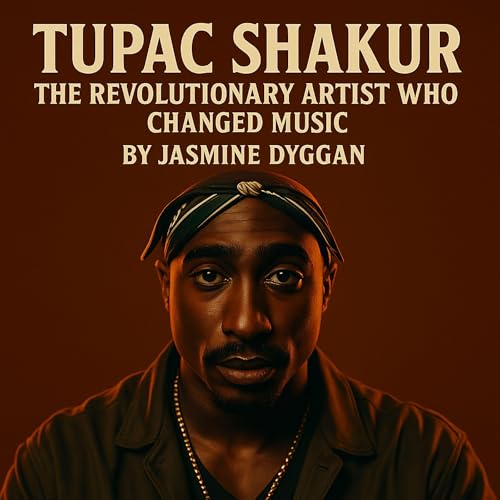
Tupac Shakur
The Revolutionary Artist Who Changed Music
Falha ao colocar no Carrinho.
Falha ao adicionar à Lista de Desejos.
Falha ao remover da Lista de Desejos
Falha ao adicionar à Biblioteca
Falha ao seguir podcast
Falha ao parar de seguir podcast
Experimente por R$ 0,00

Tupac Shakur
Compre agora por R$ 20,53
-
Narrado por:
-
Kristen Walter
-
De:
-
Jasmine Dyggan
Few figures in modern music history have had an impact as profound, far-reaching, and enduring as Tupac Amaru Shakur. His name alone evokes raw emotion — admiration for his brilliance, nostalgia for a golden age of hip-hop, and sorrow for a voice silenced too soon. But Tupac was never just a rapper. He was a poet, an actor, a revolutionary thinker, and a mirror reflecting society’s triumphs and failures. His work remains a living testament to the power of truth told through art.
In this compelling new exploration, Tupac Shakur: The Revolutionary Artist Who Changed Music, Jasmine Dyggan delves deep into the man behind the myth. Each chapter examines a different facet of his extraordinary life — from his politically charged upbringing and his meteoric rise to fame, to his profound social commentary, cinematic promise, and the mystery surrounding his tragic death.
The story begins where all revolutions do — with roots. Raised by a mother who was a prominent member of the Black Panther Party, Tupac grew up surrounded by political struggle, activism, and a deep understanding of injustice. His early exposure to poverty, racial inequality, and resistance shaped both his worldview and his art. This foundation would later define his lyrics, his interviews, and his relentless commitment to giving a voice to those who had none.
The book captures his transition from a backup dancer for Digital Underground to a solo artist whose debut album, 2Pacalypse Now, shook the cultural landscape. Through raw honesty and fearless storytelling, Tupac confronted issues that mainstream America often chose to ignore — police brutality, poverty, and systemic racism. His music wasn’t just entertainment; it was documentation, a social record wrapped in rhythm and rhyme.
Dyggan highlights how Tupac became the “voice of a generation,” speaking uncomfortable truths that resonated far beyond the borders of hip-hop. His songs like “Brenda’s Got a Baby,” “Keep Ya Head Up,” and “Changes” were not mere hits; they were rallying cries for awareness, empathy, and change. He was never afraid to expose the pain behind the pride, showing that vulnerability and strength could coexist — that you could be both revolutionary and human.
Beyond music, the book explores Tupac’s blossoming acting career, which proved his talent transcended any single medium. From his breakthrough role as Bishop in Juice to the heartfelt performance opposite Janet Jackson in Poetic Justice, Tupac’s ability to inhabit complex characters revealed a depth of artistic skill that rivaled his lyrical genius.
Dyggan also unpacks the meaning behind one of the most misunderstood phrases in pop culture: “Thug Life.” For Tupac, it wasn’t about glorifying crime — it was about survival, resilience, and a code of ethics for those living in neglected communities. It symbolized the reality of the streets and the strength it took to endure them.
The book takes listeners through the height of his fame — the chart-topping anthems, the controversies, and the relentless spotlight that turned his life into a media circus. Albums like Me Against the World and All Eyez on Me redefined hip-hop’s reach, while songs such as “California Love” became timeless cultural landmarks.
Dyggan handles with care the complex and dangerous East Coast vs. West Coast feud that cast a shadow over the mid-1990s music scene. She contextualizes it not as mere rivalry, but as a tragic cultural fracture — one that reflected deeper divisions within the music industry and society at large.
©2025 Deep Vision Media t/a Zentara UK (P)2025 Deep Vision Media t/a Zentara UK