Sinopse

Missed the live show? Catch the best moments every day with Steve Harvey and his crew Shirley Strawberry, Carla Ferrell, Nephew Tommy, and Junior in this laugh-out-loud, can’t-miss recap of the #1 syndicated morning radio show in America. Follow and subscribe so you don’t miss the best of the best!

The Best of The Steve Harvey Morning Show brings you the funniest, most uplifting, and most unforgettable moments from Steve’s four-hour morning broadcast... all in a tight, on-demand package you can enjoy anytime. With a perfect blend of humor, heart, and high-energy entertainment, this podcast keeps you in the loop and laughing, even if you missed the full show. Subscribe now, leave a review, and share the love... because your mornings deserve a highlight reel!

2026 iHeartMedia, Inc. © Any use of this intellectual property for text and data mining or computational analysis including as training material for artificial intelligence systems is strictly prohibited without express written consent from iHeartMedia
Episódios
  • Financial Tips: He introduces four financial pillars: management of wealth, real estate, business ownership and investing.
    Apr 20 2026
    Listen and subscribe to Money Making Conversations on iHeartRadio, Apple Podcasts, Spotify, www.moneymakingconversations.com/subscribe/ or wherever you listen to podcasts. New Money Making Conversations episodes drop daily. I want to alert you, so you don’t miss out on expert analysis and insider perspectives from my guests who provide tips that can help you uplift the community, improve your financial planning, motivation, or advice on how to be a successful entrepreneur. Keep winning! Two-time Emmy and Three-time NAACP Image Award-winning, television Executive Producer Rushion McDonald interviewed Dr. George C. Fraser. Interview Purpose The purpose of this interview is to educate, challenge, and mobilize listeners—particularly within the Black community—toward financial literacy, economic empowerment, and generational wealth creation. Dr. Fraser uses his platform to stress that financial freedom is not accidental; it is the result of disciplined habits, strategic thinking, and collective economic action. He also emphasizes the critical role of networking, education, and ownership in shifting long‑standing economic disparities. Core Themes Discussed 1. Financial Literacy as a Survival Skill Dr. Fraser repeatedly emphasizes that financial illiteracy is dangerous and self‑defeating. He notes that many people are never formally taught how money works, leading to avoidable financial hardship. He argues that talking openly about money—in families, churches, and communities—is essential for progress. 2. The Three Rules of Financial Freedom Dr. Fraser outlines three foundational rules that, if consistently followed, lead to financial stability and independence: Housing costs should not exceed one week’s incomeOnly borrow money to make moneyAs income increases, cost of living should stay the same or decrease These rules are positioned as practical guardrails that protect individuals from overextension and debt traps. 3. Habits That Keep People Broke The interview details six destructive financial habits, including impulse buying, misuse of credit cards, paying minimum balances, and failing to build an emergency fund. Dr. Fraser stresses that these habits compound over time and prevent long‑term wealth accumulation.txt). 4. Generational Wealth Requires Structure Dr. Fraser introduces four pillars necessary for intergenerational wealth transfer: Proper management of accumulated wealthReal estate ownershipBusiness ownershipIntentional investing He explains that income alone does not create wealth; systems and ownership do.txt). 5. From Consumption to Ownership A recurring message is the need to shift from being a consumer class to becoming a producer and merchant class. Dr. Fraser encourages entrepreneurship at every level—no matter how small—to build ownership and control economic outcomes.txt). 6. Networking and Collective Economics Dr. Fraser highlights the importance of strategic networking and introduces concepts behind FraserNet and virtual economic ecosystems designed to connect Black professionals, businesses, and intellectual capital globally. He frames networking as an economic strategy, not a social activity. Key Takeaways Financial freedom follows rules, discipline, and education, not luckTalking openly about money is essential to breaking cycles of povertyDebt should only be used as a tool to produce returnsLiving below one’s means creates capital for investingGenerational wealth requires planning, ownership, and systemsMultiple income streams are no longer optional—they are necessaryNetworking is a vehicle for wealth creation and scale Notable Quotes “Your rent or mortgage should be no more than what you make in a week.” “Only borrow money to make money.”. “As your income increases, your cost of living should decrease or stay the same.”. “Stop living above your means. Stop living within your means. Live below your means—and invest the rest.”. “We are at the bottom of every economic statistic that matters. Education is the answer.”. “There should not be a Black person in America with a single stream of income.” “In America, somebody is always buying and somebody is always selling. Stop doing all the buying—sell something.”. Conclusion Dr. George C. Fraser’s interview serves as a call to action. It challenges listeners to confront unhealthy financial habits, embrace education, prioritize ownership, and build networks that support long‑term economic empowerment. The conversation underscores that true wealth is not about income alone, but about control, discipline, and legacy #SHMS #STRAW #BESTSteve Harvey Morning Show Online: http://www.steveharveyfm.com/See omnystudio.com/listener for privacy information.
    Exibir mais Exibir menos
    23 minutos
  • Community Uplift: Well With All produces wellness products and donates 20% of its profits to health‑equity initiatives.
    Apr 19 2026
    Listen and subscribe to Money Making Conversations on iHeartRadio, Apple Podcasts, Spotify, www.moneymakingconversations.com/subscribe/ or wherever you listen to podcasts. New Money Making Conversations episodes drop daily. I want to alert you, so you don’t miss out on expert analysis and insider perspectives from my guests who provide tips that can help you uplift the community, improve your financial planning, motivation, or advice on how to be a successful entrepreneur. Keep winning! Two-time Emmy and Three-time NAACP Image Award-winning, television Executive Producer Rushion McDonald interviewed Demond Martin. Co‑founder and CEO of Well With All, a Black‑owned purpose‑driven wellness brand—joins Rushion McDonald to discuss health equity, entrepreneurship, his life story, his upcoming book Friends of the Good, and his new $1M AI Health Equity Prize. Martin shares how his difficult upbringing in the projects and rural North Carolina shaped his commitment to giving back. After a successful 21‑year career as the only Black partner at a major hedge fund, he launched Well With All to merge consumer products, wellness, and social impact. The brand donates 20% of its profits to health‑equity initiatives. He discusses product innovation, the importance of supplements in underserved communities, the power of Black longevity, and the need to prepare younger generations for healthier futures. He also explains his upcoming book—which uses Aristotle’s philosophy of “friends of the good” to show how meaningful relationships enable success. The conversation is energetic, inspirational, and focused on using business as a force for social good. 🎯 Purpose of the Interview The interview aims to: 1. Introduce Well With All A wellness company offering supplements and energy drinks while funding health‑equity solutions. 2. Share Martin’s Personal Journey From poverty, trauma, and instability → to White House, Harvard Business School, and a top hedge fund. 3. Promote His Book, Friends of the Good A philosophy‑driven exploration of friendship, mentorship, and community. 4. Announce the $1 Million AI Prize A major initiative to scale AI tools that close health‑equity gaps. 5. Encourage Health Awareness in Underserved Communities Particularly around longevity, dietary choices, energy consumption, and supplement use. 🔑 Key Takeaways 1. Health Equity Drives the Mission Martin emphasizes that health is a human right and disparities in nutrition, maternal health, and mental‑health access must be addressed. 2. Well With All = Social Impact + Consumer Products The company donates 20% of profits and creates healthier alternatives (energy drinks, supplements) to replace harmful daily habits like sugary sodas. 3. Personal Story Fuels Commitment He overcame poverty, a traumatic home life, and limited opportunity—and believes he survived because others poured into him. 4. Mentorship Changed His Life Major turning points included: Student body president at UNC CharlotteAssistant to the White House Chief of StaffHBS acceptanceTraining under hedge‑fund leader Phil Gross 5. Expertise Matters His success with Well With All is grounded in 21 years as an investor specializing only in consumer companies. 6. AI Can Close Health Gaps The $1M Well With All Prize supports AI tools already impacting at least 1,000 lives with the potential to scale to 100,000+. 7. Black Longevity Documentary His company created a film (NAACP Image Award–nominated) featuring Black elders aged 85–106 to redefine narratives around Black health. 8. The Power of Friendship His book teaches readers how to identify “friends of the good,” the relationships that define one’s path and joy. 🗣️ Notable Quotes from Demond Martin (from the transcript) (All quotes sourced from:) On Health Equity “Health is a human right. Everyone deserves nutritious food… everyone deserves to see a doctor.”“Where With All is not just a brand—it's a movement.” On His Upbringing “I grew up in the projects… lived in a trailer… had a heroin addict as a stepfather. I’ve seen things that gave me perspective.” On Perspective and Survival “If this was me at 14… I’d be dead or in jail.” On His Mission “I need to start giving back today. I’ve lived a life of giving back—my parents and grandparents instilled that in me.” On Product Philosophy “Small, incremental choices add up. Replacing one sugary soda a day is 45,000 fewer calories a year.” On Expertise “All I did for 21 years is invest in consumer companies. That was my expertise.” On Friendship & His Book “Show me your friends, I’ll show you your future.”“Friendship is one of the most essential elements of joy.” On Confidence & Mastery “Five years into my career, I knew I knew what the hell I was doing.” On AI “We’re not rewarding ideas—we’re rewarding impact.” #SHMS #STRAW #BESTSteve Harvey ...
    Exibir mais Exibir menos
    33 minutos
  • Financial Tips: He stresses taking ownership of your financial future rather than leaving the burden to your children.
    Apr 19 2026

    Listen and subscribe to Money Making Conversations on iHeartRadio, Apple Podcasts, Spotify, www.moneymakingconversations.com/subscribe/ or wherever you listen to podcasts. New Money Making Conversations episodes drop daily. I want to alert you, so you don’t miss out on expert analysis and insider perspectives from my guests who provide tips that can help you uplift the community, improve your financial planning, motivation, or advice on how to be a successful entrepreneur. Keep winning!

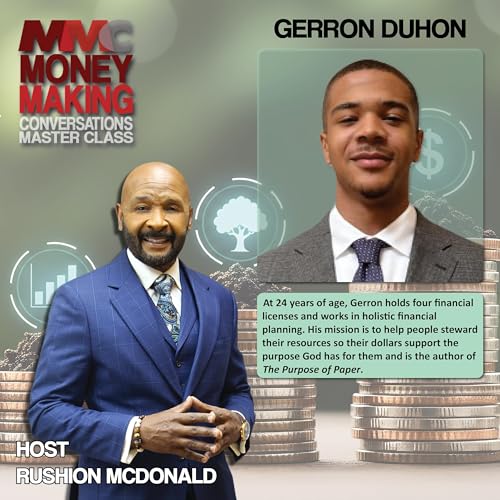
    Two-time Emmy and Three-time NAACP Image Award-winning, television Executive Producer Rushion McDonald interviewed Gerron Duhon.

    Purpose of the Interview

    The conversation aimed to:

    • Highlight the importance of financial literacy for young adults.
    • Share Jerron Duhon’s personal journey from Lake Charles, Louisiana, to Yale University and into holistic financial planning.
    • Promote his book “The Purpose of Paper”, which focuses on building generational wealth and breaking harmful financial habits.

    Key Takeaways

    1. Personal Journey & Identity Shift

      • Jerron used football as a “meal ticket” to escape his hometown, but a concussion ended his athletic career, causing an identity crisis.
      • He pivoted toward financial education and wealth creation, emphasizing long-term planning.
    2. Misconceptions About Wealth

      • Many young adults believe wealth comes quickly through gambling, sports betting, or flashy investments.
      • Social media fuels the desire to display wealth rather than build wealth, leading to poor financial decisions.
    3. Financial Habits & Framework

      • Jerron introduced his AIMS framework:
        • Awareness: Know your current financial state.
        • Intention: Set clear goals and reverse-engineer steps.
        • Mindset Change: Focus on future self, not old habits.
        • Systems: Automate savings and investments to reduce reliance on willpower.
    4. Faith and Finance Connection

      • Principles like self-control, patience, and hope—fruits of the spirit—are essential for financial discipline.
      • “Faith without works is dead” applies to money: belief must be paired with action.
    5. Generational Wealth

      • Gerron stresses taking ownership of your financial future rather than leaving the burden to your children.
      • Investing should be strategic and long-term, not like playing the lottery.
    6. Practical Advice

      • Start small but consistent (e.g., $150/month).
      • Use modern tools like Robinhood for stock investing.
      • Shift from being a consumer to an owner (invest in companies you use).

    Notable Quotes

    • “Football was my meal ticket… but I realized I didn’t dream far enough.”
    • “We connect our financial decisions to display wealth instead of to build wealth.”
    • “Faith without works is dead—just like in finances.”
    • “Are you going to be the one that changes your generation, or will you leave that pressure on your children?”
    • “Good advice is timeless.”

    #SHMS #STRAW #BEST

    Steve Harvey Morning Show Online: http://www.steveharveyfm.com/

    See omnystudio.com/listener for privacy information.

    Exibir mais Exibir menos
    28 minutos
Ainda não há avaliações