Episódios

  • What’s behind Trump’s latest Canada threats?
    Feb 5 2026

    Last week the U.S. Treasury Secretary Scott Bessent issued a very public warning to Prime Minister Mark Carney. At the centre of that warning is the USMCA trade deal, which kept Trump’s tariffs from unleashing even deeper damage to the Canadian economy.

    A mandatory review of the US-Mexico-Canada pact is kicking-off now. It has turned into a high stakes negotiation, with the U.S. poised to squeeze Canada and Mexico and to use the negotiation itself as leverage to advance the administration’s interests.

    Today, trade expert Eric Miller is back to talk about where the trade talks are headed, what the Americans are hoping for, and what would happen if the deal got ripped up altogether. Miller is the president of Rideau Potomac Strategy Group and a fellow at the Canadian Global Affairs Institute.


    For transcripts of Front Burner, please visit: https://www.cbc.ca/radio/frontburner/transcripts

    Exibir mais Exibir menos
    31 minutos
  • Epstein’s orbit: will justice come?
    Feb 4 2026

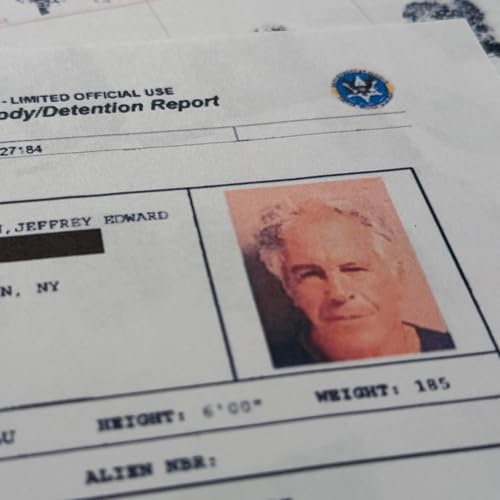
    Jeffrey Epstein’s vast connections with the rich and powerful, the world over, are on full display in the over 3 million files and documents released by the U.S. Justice department late last week.


    There’s mounting evidence of Epstein’s relationships with people like President Trump’s former chief strategist Steve Bannon, former Israeli Prime Minister Ehud Barak and tech titan Peter Thiel, as well as behind the scenes dealmaking with global power brokers.


    Today, we go over the biggest revelations with Politico senior legal affairs reporter Kyle Cheney. We also discuss why so few have been held accountable.


    For transcripts of Front Burner, please visit: https://www.cbc.ca/radio/frontburner/transcripts

    Exibir mais Exibir menos
    31 minutos
  • What happens in ICE detention?
    Feb 3 2026

    Around 73 thousand people have been detained in ICE facilities across the United States over the past year. That’s a 75 per cent increase from right before Donald Trump took office. At least 38 people have died in ICE custody since then.


    It’s all part of the Trump administration’s rapidly expanding immigration crackdown, which has included the addition of over one hundred new facilities. One of those facilities, in south Florida, has been dubbed Alligator Alcatraz. In December Amnesty International USA detailed conditions there, finding they amounted to quote “cruel, inhuman and degrading treatment”.


    Amy Fischer, Director for Refugee and Migrant Rights at Amnesty International USA joins us to talk about what happens when people are detained by ICE and what, if anything, courts and lawmakers can do to stop it.


    For transcripts of Front Burner, please visit: https://www.cbc.ca/radio/frontburner/transcripts

    Exibir mais Exibir menos
    29 minutos
  • Politics! Poilievre’s win, election speculation
    Feb 2 2026

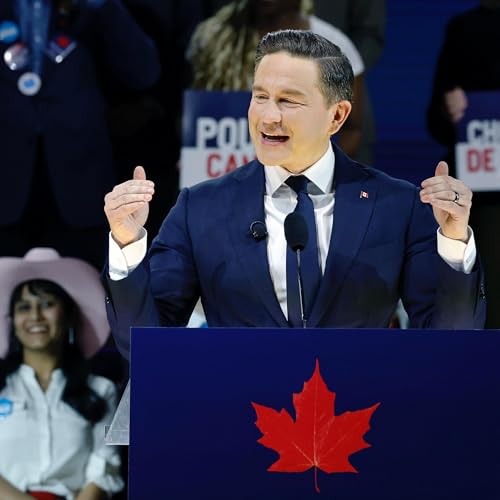
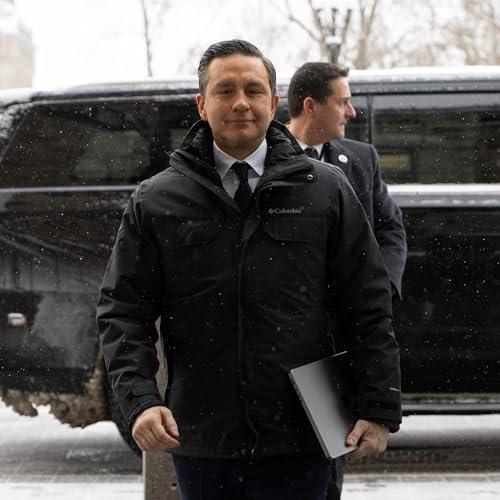
    Pierre Poilievre easily won his leadership review in Calgary on the weekend with 87.4% of the vote. Today, senior Parliamentary bureau writer Aaron Wherry talks about the convention, whether it guarantees Poilievre’s future and what challenges still lie ahead for the Conservative leader. Plus, why a press conference at a grocery store prompted election speculation.


    For transcripts of Front Burner, please visit: https://www.cbc.ca/radio/frontburner/transcripts

    Exibir mais Exibir menos
    30 minutos
  • Leader or loser: Poilievre’s crucial vote
    Jan 30 2026

    In just over a decade, the Conservative Party of Canada has lost four elections, picked three new leaders, and turned on two of them when they failed to become Prime Minister. As the party votes on Pierre Poilievre’s future as leader of the Conservative Party, Front Burner speaks to Conservative insiders, Abacus Data CEO David Coletto and senior parliamentary writer Aaron Wherry to consider the path the Conservatives took to this point and whether Poilievre can keep the party united behind him.

    Exibir mais Exibir menos
    37 minutos
  • Trump 2.0’s Nazi-coded social feeds
    Jan 29 2026

    Over the last few weeks, the Trump administration has explicitly or implicitly borrowed from the Nazi tradition on social media.


    Specific passages or iconography from the Third Reich have been repurposed in the context of the government’s own legislative program today. The adoption of these extreme symbols, dog whistles and phrases is part of a re-mainstreaming of fascist and Nazi ideas more broadly.


    Ali Breland, a staff writer at The Atlantic, explains why he sees it as part of an attempt to remake the U.S. from a country defined by ideas like liberty and equality, to one defined by bloodline and heritage.

    Exibir mais Exibir menos
    26 minutos
  • Is MAGA weaponizing Alberta separatism?
    Jan 28 2026

    U.S. Treasury Secretary Scott Bessent has weighed in on the separatism movement in Alberta. Bessent has said that the province is a “natural partner” to the U.S., and that it has “great resources”.


    While Bessent is certainly the most high profile U.S. official to muse about Alberta separatism, he hasn’t been the only MAGA supporter to chime in. Donald Trump’s former chief strategist Steve Bannon and Republican congressman Andy Ogles have also waded into the debate.


    Today we’re asking why MAGA is eyeing Alberta separatism and whether it’s a threat to Canada’s national security.


    Joining us: Jason Markusoff, writer and producer for CBC Calgary, and Patrick Lennox, a national security expert who ran for the Liberals in the last federal election in Edmonton. We’ll also hear from Jeffrey Rath, legal counsel and spokesperson for the Alberta Prosperity Project. That’s the main advocacy group pushing for Alberta independence.


    For transcripts of Front Burner, please visit: https://www.cbc.ca/radio/frontburner/transcripts

    Exibir mais Exibir menos
    30 minutos
  • Can NATO survive Trump?
    Jan 27 2026

    Last week, U.S. President Donald Trump set off a firestorm with comments dismissing the military contributions of fellow NATO members during the war in Afghanistan.


    This follows the president’s aggressive bid for Greenland, a self-governing territory of NATO-ally Denmark, which brought into question whether NATO, the North Atlantic Treaty Organization, could survive without America, its strongest and richest member.


    And while some kind of agreement on Greenland now seems to be on the table, and Trump appears to be backing down, today we’re asking what damage has already been done to NATO. How does this latest challenge to its existence compare to conflicts the military alliance has faced before? Aaron Ettinger, a professor of political science at Carleton University, joins us for a conversation about how NATO’s past and present could inform its future.


    For transcripts of Front Burner, please visit: https://www.cbc.ca/radio/frontburner/transcripts

    Exibir mais Exibir menos
    30 minutos