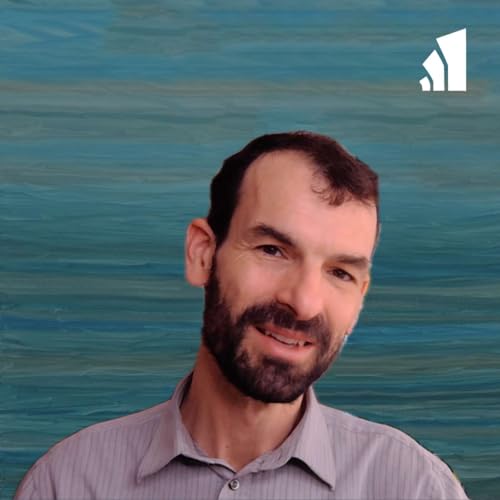
Questions of Courage Podcast Por Nathaniel Williams capa

Questions of Courage

Questions of Courage

De: Nathaniel Williams
Ouça grátis

Sobre este título

“Questions of Courage” is a video/podcast with Nathaniel Williams, leader of the Youth Section at the Goetheanum. It is an independent and unique look at questions related to technology, education, art, ecology, vocation, community, justice and meaning require a deeper, spiritual take on life. The ability to take up these issues from this perspective is a question of courage.© 2025 Nathaniel Williams Ciências Sociais
Episódios
  • The Courageous Thinking of Bergson
    Dec 13 2025

    Bergson, intrigued by the riddle in the differences between lived experience and abstract explanation, forged a remarkable path of insight and exploration through his life. This short video offers a short impression of the riddles that he treated like seeds, which he grew into unique vision of evolution and human freedom, and the origin of matter as creative life.

    References:

    Henri Bergson, Creative Evolution. (North Chelmsford, MA: Courier Corporation)

    and An Introduction to Metaphysics. (Hackett Publishing).

    Questions of Courage is a project of the Youth Section at the Goetheanum, in collaboration with Goetheanum TV.

    To support the Youth Section Global Access Fund, please visit: https://www.goetheanum.org/en/youth-donations.

    Exibir mais Exibir menos
    15 minutos
  • Courage in the Academy
    Dec 1 2025

    This video could be of interest for young people studying in the academy who are considering exploring spiritual approaches to understanding and knowledge. Williams introduces a handful of scholars who have dedicated significant time to researching and publishing on Rudolf Steiner’s work and legacy, and why research in this area can take courage.

    References:

    Christian Clement preface to: Rudolf Steiner, Band 13: Schriften über soziale Dreigliederung, frommann-holzboog verlag

    Dan McKanan, Eco-Alchemy: Anthroposophy and the History and Future of Environmentalism. (Oakland, CA: University of California Press).

    Peter Staudenmaier, Between Occultism and Nazism: Anthroposophy and the Politics of

    Race in the Fascist Era. (BRILL).

    Helmut Zander, Anthroposophie in Deutschland: theosophische Weltanschauung und

    gesellschaftliche Praxis 1884-1945. (Vandenhoeck & Ruprecht)

    Questions of Courage is a project of the Youth Section at the Goetheanum, in collaboration with Goetheanum TV.
    To support the Youth Section Global Access Fund, please visit: https://www.goetheanum.org/en/youth-donations.

    Exibir mais Exibir menos
    13 minutos
  • Freedom What?
    Nov 12 2025

    I have read two longer book reviews in recent months, both in influential journals, of the growing consensus that human freedom is an illusion. The consequences elude me, and I turn to satire for relief. “Scientists around the world reach consensus that freedom is an illusion, they have now turned to the question of what the significance of this conclusion can be given they are unsure exactly what conditions have brought it about.” Thinking stalls and turns in on itself in free fall. I am trying to get a small piece of shell out of the egg white and each time I stab with my finger it is displaced. I am an artist that is drawing the world but when I try to draw myself, graphite becomes rubber and suddenly erases my presence. I am a latent view from nowhere. I live in an element that conducts world-consciousness and insulates self-knowledge, a substance that reveals a world to me while concealing myself. As far as I am concerned, celebrated conclusions of thought accentuate riddles they profess to solve.

    But of course, there is, after all, natural science and the expanded majesty of the universe. Satisfaction wells up as thought marries action in physics and rockets fire and fly. But after I have spent late nights staring at the bottom of the glass, taking my fill of a union of mind and matter, intoxicated with the necessary interdependence of the great material mathematical matrix, I am sick as the sun rises. Sunrise greets me with the penetrating question of why, while the how of a necessary and functional web of cause and effect entices me away from the headache and back to sleep. I am drawn to the hair of the dog that bit me as a remedy, as a morning headache following a night of drinking might be softened by a glass of beer.

    But fascination with mytho-mechanics is a puzzle to put together only so many times in the nerd - crazed vitalism of alienation before it whispers its secret:

    Silence.

    The world, my unproven gold standard of reality, won’t testify. I am the secret the world keeps to itself in speechlessness. I am the taboo of the universe. I thought I heard a poem in a rainstorm. A message of light flashed at me through leaves in the wind in September, but where I walk eyes turn away and voices fade. In these reveries a bustling crowd of life and meaning disperses, hushing into echoes and whispers with my approach. I go to work on the subtly ensouled scenes but sensation fades with my attention, as if my wandering thought is the expert anesthesiologist. I face the numb, unconscious world and feel I am practicing the wrong science, I want to administer not anesthetic but aesthetic attention.

    I do not belong to the world of things and I sense myself as infinite, me the great nothing of helpless life. I, the strange fruit of the world, a living symbol, an orphan birthed by a universe that seems to have passed away in hard labor. Can the child live? This child of the world, can it grow into its kin, the All? In the past the rivers spoke, as did the stars, and their words were a Theo-sophy or Gnosis. Wisdom was living spiritual revelation of community ritual and cosmos. From that old and wonderful, wise and atavistic puppet magic, all full of reverent acceptance of life before science, the disenchantment was born to children, all vulnerable, but most precious. How can this child grow save through loving the corpse, not simply its inert, mytho-mechanical form, but as a body that has not quite yet gone back to dirt, wherein the beautiful forms of a once living divine presence is still visible, if devoid of the living self? From what once moved with life may some form of Anthropo-sophy arise through love of this beautiful countenance? Then freedom may involve resurrecting the world through beautiful, heartfelt knowledge. It may involve a new, extra-mechano-morphic meaning, emerging in creative, thinking hearts.

    Questions of Courage is a project of the Youth Section at the Goetheanum, in collaboration with Goetheanum TV.
    To support the Youth Section Global Access Fund, please visit: https://www.goetheanum.org/en/youth-donations.

    Exibir mais Exibir menos
    9 minutos
Ainda não há avaliações